
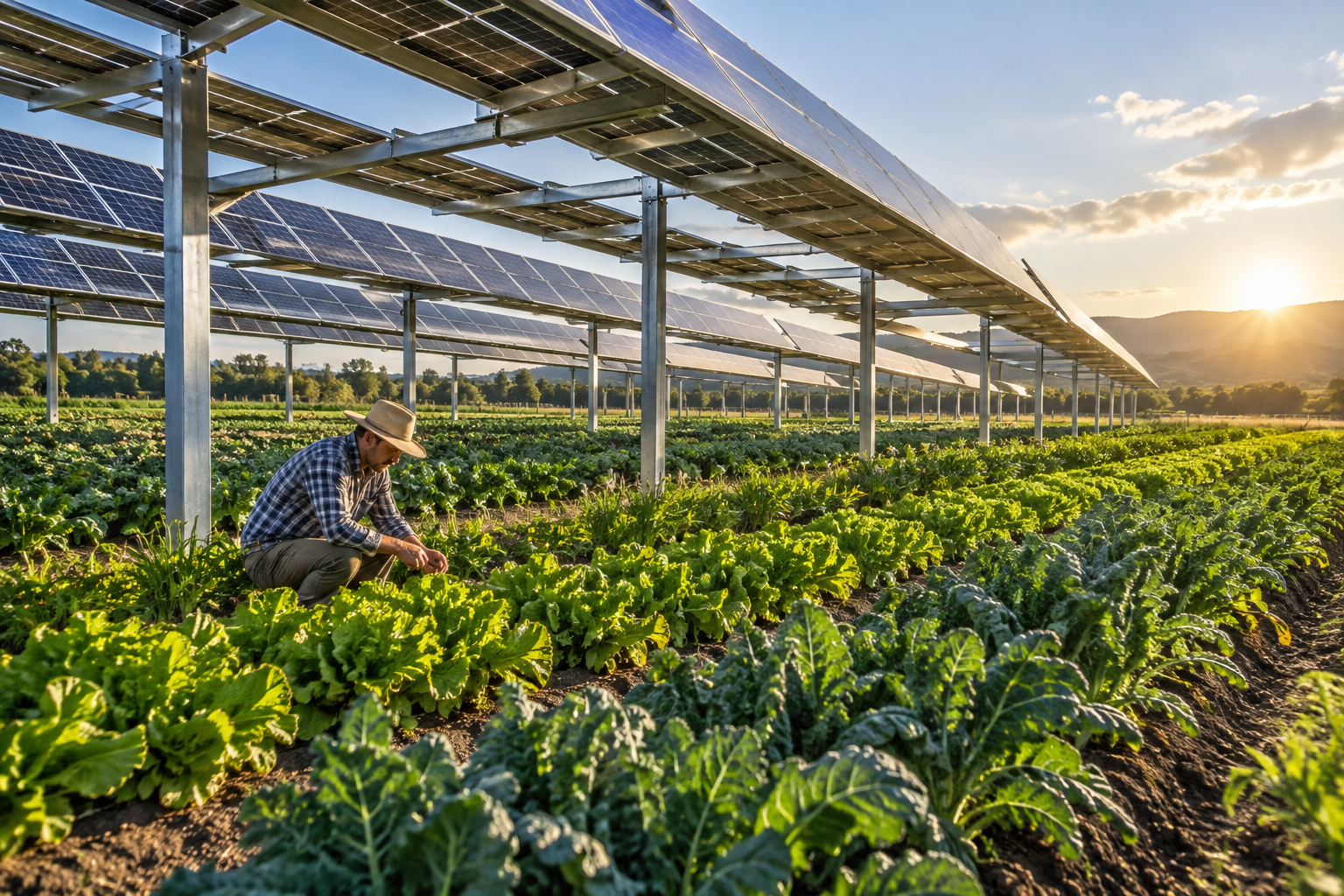
Solar development and food production are often presented as competing uses of land. Agrivoltaic farms challenge that assumption by placing elevated panels above or between crops. The arrangement allows sunlight to generate electricity while farmers continue using the soil below. When designed around local crops and climate, the shared system can create benefits that neither activity would deliver alone.
Panel height and spacing shape the farm
Agrivoltaics is not simply a conventional solar field with vegetables added afterward. Engineers must leave enough height for workers and machinery, while rows need spacing that provides useful light across the growing season. Some systems use fixed panels, and others rotate to manage both energy production and shade. Farmers remain central to the design because crop schedules, irrigation lines and harvesting equipment determine what will work in daily practice.
Partial shade can reduce heat stress for leafy greens, berries and other sensitive crops. Soil may retain moisture longer because less water evaporates during the hottest hours. Panels can also shelter workers and plants from intense sun or light hail. However, too much shade can reduce yields, especially in cooler regions or for crops that require long periods of direct light. Field trials are essential before a system is expanded.
Two income streams can improve resilience
Electricity sales or lease payments can provide steadier revenue when harvest prices fluctuate. At the same time, continued farming helps communities preserve productive land and agricultural employment. Some projects also combine panels with grazing, pollinator habitat or rainwater collection. These additional uses must be managed carefully so that attractive claims are supported by real agricultural outcomes.
Costs remain a barrier. Elevated structures use more steel and require more complex installation than standard solar arrays. Maintenance teams need safe access without compacting soil or damaging crops. Local permitting rules may not clearly define a site that is both a power facility and a working farm. Clear contracts are particularly important when the landowner, farmer and energy operator are different parties.
Measurement should guide expansion
Researchers compare crop yield, water use, soil temperature and electricity production across multiple seasons. Results vary by crop, panel design and region, so one successful pilot cannot be copied everywhere. Transparent data helps farmers decide whether the higher construction cost is justified.
Agrivoltaics will not replace every solar farm or fit every field. Its value lies in giving communities another option. With thoughtful design, the same land can support food, clean power and more resilient rural economies.